28 June 2012

Sustainability


Definition:  There are several ways to define sustainability.  One, attributed to the “Brundtland Commission” considers sustainability to be the ability to satisfy current needs without compromising the ability of future generations to meet their needs.  This definition rests on intergenerational equity.  The second generation focuses on equity at the current moment, and holds the needs of classes, ethnic groups, or nations who are less empowered, to have a legitimate stake in the satisfaction of needs.  A third definition can also be identified.  It focuses on the capacity of people to live within the capacities of ecosystems to  support them.  This, in a sense, is the most fundamental definition of sustainability.  It hews very close to the ordinary definition of sustainability in the sense of sustenance or support. 


Examples:  Applying the concept of sustainability to urban systems requires some caution.  From an environmental standpoint, no urban area is strictly sustainable.  Large urban areas, including suburbs, and their non-agricultural exurbs, do not supply their own food, cleansing capacities, or other environmental benefits (see Ecosystem Services).  However, city, suburban, exurban systems that contribute toward their food needs, environmental cleansing, carbon storage, and pollution reduction, for example, can be said to be more sustainable than those which do not make the same kinds of contributions.  Urban sustainability is thus a relative condition.

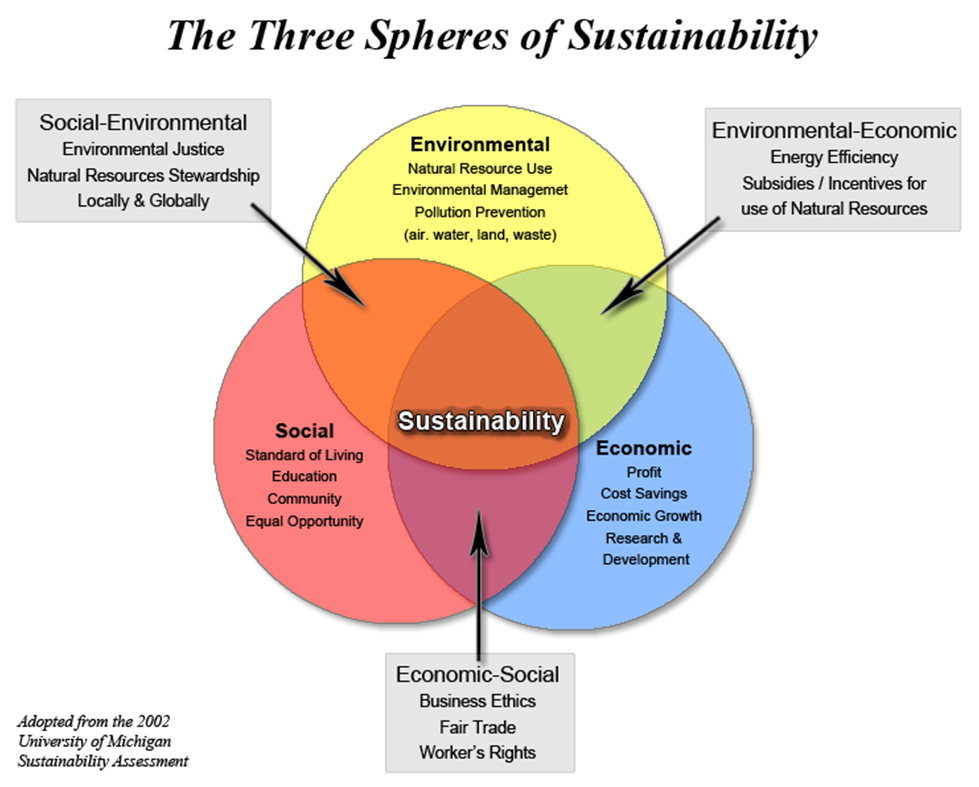
Sustainability has three components: environmental, social, and economic.  There is benefit to achieving sustainability in each realm, and the overlaps between each pair also has value, as noted by the grey boxes.  However, true and lasting sustainability can only result from the overlap of all three areas.  In other words, sustainability in any one area—environment, social, or economic—without attention to the other two will ultimately fail.    
 
Why important:  No activity that claims a benefit to sustainability can be narrowly construed.  All definitions of sustainability from the 1980s on, recognize that sustainability has three inextricably linked components – economic, social, and environmental.  Thus, people often speak of a “triple bottom line” in making any decision, so that the health of the economy, of the environment, and of social equity are all supported by decisions and actions that enhance sustainability.  None of the three aspects of sustainability trumps the others.  Given that urban sustainability is a relative condition, there are many activities and strategies cities, suburbs, and urbanized exurbs can make toward sustainability.

For more information:
Williams, D.E. 2007.  Sustainable Design: Ecology, Architecture, and Planning.  Wiley, Hoboken NJ.
Curwell, S., M. Deakin, and M. Symes, editors. 2005. Sustainable urban development, volume 1: the framework and protocols for environmental assessment. Routledge, New York.

Suburb


Definition: A suburb is a section of a metropolitan area primarily devoted to residential use, in which single household dwellings having attached yards predominate, and where transpiration is provided mainly by the automobile.  Suburbs originate on the outskirts of a city, but over time, may be engulfed by similar developments or by commercial and light industrial districts. 

Examples: The original America suburbs were such areas as Millburn, NJ or Oak Park, Illinois.  These developments were intended to have broad, contiguous lawns giving the individual households a sense of being part of a single park. 

Figure 1. Suburban sprawl in Blue Ash, metropolitan Cincinnatti, OH.  From: Queencitydiscovery.blogspot.com

Figure 2. The prewar city of Dayton, Ohio, compared to postwar suburban sprawl.  From daytonology.blogspot.com.
 

Why important: Although the early suburbs of the 19th century were sometimes serviced by streetcars or trolley lines, they quickly evolved into bastions of the passenger automobile, with sweeping curved streets and cul de sacs.  After World War II in the United States, the suburb took on its iconic form, and sprawled well beyond the borders of central cities.  Such sprawl consumed, and continues to consume, active agricultural land, agricultural land that is no longer profitable or worked, forest, desert, and chaparral shrubland.  Some suburban development leapfrogs over non-urban land to form distant exurbs which interdigitate with wild or production lands, but which themselves house residents whose sensibilities and economic attachments are urban rather than rural or land-based.  The suburb is now the center of demographic and economic gravity in most American metropolitan areas.  American style suburbanization is increasingly found in other countries.  The structure and segregated functions of suburban areas have many environmental and social costs, as well as serving residents with personal open space, proximity to green infrastructure, and a high degree of household control of their immediate surroundings.  Currently, some suburbs are valued for the high quality of their schools, availability of light industrial and commercial activity and employment, and ease of access to consumer culture.  Suburbs in many cases, stand in contrast in terms of density, transportation, investment, infrastructure, demographics and ethnicity to urban areas in the strict sense.  Suburban environments with sufficient green space can contribute to ecosystem services in urban systems; however they also contribute inefficiencies of energy and transportation.

For more information:
Hayden, D. 2003. Building suburbia: green fields and suburban growth 1820-2000. Pantheon, New York.
Garreau, J. 1991. Edge city: life on the new frontier. Doubleday, New York.
Groffman, P.M., N.L. Law, K.T. Belt, L.E. Band, and G.T. Fisher. 2004. Nitrogen fluxes and retention in urban watershed ecosystems. Ecosystems 7:393-403.

Ecology


Definition: The scientific study of the processes influencing the distribution and abundance of organisms, the interactions among organisms, and the interactions between organisms and the transformation and flux of energy and matter.

Examples: Ecology is a synthetic science.  Although it arose from the focus of 19th century biology on organisms, as techniques, places studied, and other sciences have changed, so too ecology has expanded its scope.  Ecology now covers a gradient of topics, ranging from integration with geology and Earth sciences on one extreme, to genetics and physiology at the more biological extreme.  In between, ecology studies ecosystems, landscapes, populations, communities, and individuals.  It focuses on the structure, function, and change of the various entities it studies, and it highlights interactions between physical and living components of systems.  

Ecology Figure 1. Ecology is a complex discipline that combines a concern with abiotic, or physical, and biotic, or living components. It overlaps with both physical science and biological science disciplines, and within it, has many specialties that differ by their degree of emphasis on the biological or the physical, and on the nature of their subject matter. 

Why important: Because ecology is fundamentally a synthesizing science, it is well poised and suited to linking with the other disciplines and professions needed to understand, design, and manage urban systems.  The term ecology is sometimes used to describe a particular model of ecological interactions or a network of processes.  The term has also been appropriated by other disciplines, such as political ecology, social ecology, and the like.  When used in the plural, as “ecologies” by certain disciplines, it is likely that different models, scales of observation, or perspectives on a particular socio-ecological system are indicated.  In addition, the term is used metaphorically in common speech to indicate connectedness or equilibrium.  These more poetic uses are quite different from the implications of the term as a description for scientific practice and the resulting knowledge, however.

For more information:
Likens, G.E. 1992. The ecosystem approach: its use and abuse. Ecology Institute, Oldendorf/Luhe, Germany.
Pickett, S.T.A., J. Kolasa, and C.G. Jones. 2007. Ecological understanding: the nature of theory and the theory of nature, 2nd edition. Springer, New York.

11 June 2012

Metacity


Definition:
A metacity is a heterogeneous, dynamic urban region composed of multiple dense centers, intervening suburbs, embedded green spaces, and diffuse boundaries between traditional cities, suburbs, and exurbs.  Metacities are characterized as patch dynamic systems, in which neighborhoods, districts, boundaries, and the exchanges among patches change over time.  Governance in metacities is polycentric, that is, shared among different jurisdictions and with formal and informal social institutions. 

The metacity is a conceptual framework for understanding socio-ecological relationships and adaptive processes across different, specific neighborhood situations in all cities of whatever size and density, whether shrinking or growing.  It is a way of understanding any city as a patchy “system of systems,” and therefore related to metapopulation and metacommunity theory in ecology.  Metapopulations and metacommunities in ecology are spatially complex systems in which different elements – subpopulations and subcommunities, respectively -- are established or go extinct differentially.  Although the elements of any metasystem can exchange members or information periodically, each usually acts relatively independently of the others.  Differential connectivity, and differential risk of change are characteristics of “meta” systems in ecology, and these features apply to the metacity as well. 

A metacity can be conceived of as a mosaic of different landscapes.  Some of the landscape models represent the social and ecological processes, while other conceptions represent the choices that individuals and institutions make, and finally some landscapes represent the outcomes of both the processes and the choices.  Some of the outcomes are intentional and some are unintended and accidental (Figure 1).


Figure 1. The components of a metacity, conceived as landscapes defined by social and bioecological processes, by the choices that individuals and institutions make, and by the intentional and accidental outcomes of those choices.

Examples:
Baltimore is an excellent example of a metacity.  It encompasses the traditional central business district that owes its density and concentration to the industrial and transportation infrastructure and economy of earlier centuries, as well as to the shift toward a service and knowledge based economy of the 21st century.  The city of Baltimore was designed to accommodate approximately 1.2 million inhabitants.  However, since 1950, the city has lost some 30% of its inhabitants while Baltimore County and other counties in the metropolitan area have grown.  As a result there are some 16,000  abandoned houses or vacant lots in the city.  

 
Figure 2. Vacant housing and lots in Baltimore City, from the harbor north.

Consequently, some of the streets that were formerly commercial magnets now have lost that function.  On a finer scale, the commercial buildings on corners in old rowhouse neighborhoods were often the first to be abandoned as the culture of mom-and-pop stores shifted first to strip malls, and later to big box stores.  Yet at the same time, suburban areas, including relatively “urban” areas such as Towson in Baltimore County, and Columbia, in Howard County, have become more dense and more active socially and economically.  Indeed, Carroll County and some areas in nearby Pennsylvania are now linked to the urban region of Baltimore. 

While dense rowhouse neighborhoods have thinned and provided opportunities for taking advantage of rational greenspace planning, brownfields resulting from the de-industrialization of Baltimore have also proliferated in Baltimore City and Baltimore County.  Some formerly industrial areas on the Inner Harbor have been converted to entertainment venues and upscale condos and apartments.  The area known as Harbor East, now boasting new high rise office buildings, luxury hotels, organic food markets, impressive wine merchants, and creative housewares merchants has emerged cheek by jowl to the Fells Point neighborhood, known as a freewheeling, gritty neighborhood since it was founded as Baltimore’s first deep water port serving merchant vessels and the worldly men who staffed them.

In Baltimore County, with its Urban-Rural Demarcation Line (URDL) established in the 1970s, patchy development has been enshrined in code.  The “URDL” is an extraordinarily effective planning tool, encompassing some 97% of the county’s residents.  The smart growth policy of Maryland plays out very effectively in this case.  BES research by Elena Irwin and colleagues at Ohio State University has shown that “leapfrogging” beyond Baltimore County’s URDL into adjacent Carroll County is not seen in statistical analysis.  The URDL restricts suburban development to areas along designated corridors served by public transportation, interstate highways, and sanitary sewers.  This has permitted Baltimore County to work with private land holders to consolidate management of large forest tracts to contribute to the Montreal Protocol goals of carbon sequestration, for example.  The patchiness of change in the Baltimore region epitomizes the metacity as a patchy, dynamic system of systems.


Figure 3. The Urban Rural Demarcation Line (URDL) in Baltimore County.  Baltimore City, a jurisdiction separate from the county, is also shown.


Why important:
The term metacity has been used before.  It was introduced by UN-HABITAT (United Nations 2006/7) to designate hypercities of over twenty million people.  Thus, the UN definition emphasizes size.  However, according to McGrath and Pickett (2011) the term should is not be limited to large urban agglomerations, but rather connoted to include the proliferation of new and dynamic forms of urbanization, each with distinct ecological and social attributes. These various urban configurations when combined with new digital sensing, communication and social networking technologies constitute a virtual meta-infrastructure, present in all sizes of city today. This new metacity has the potential to integrate new activist forms of ecological and urban design research and practice in making the transition from sanitary to sustainable city models globally.

For more information:
McGrath, B. P., V. Marshall, M. L. Cadenasso, J. M. Grove, S. T. A. Pickett, R. Plunz, and J. Towers, editors. 2007. Designing patch dynamics. Columbia University Graduate School of Architecture, Preservation and Planning, New York.
McGrath, B. and S. T. A. Pickett. 2011. The metacity: a conceptual framework for integrating ecology and urban design. Challenges 2: 2011:55-72.  http://www.mdpi.com/2078-1547/2/4/55/
Shane, D. G. 2011. Urban design since 1945 -- a global perspective. John Wiley & Sons, Ltd, Chichester UK.
United Nations. Urbanization: Mega & Metacities, New City States; UN-HABITAT: State of the World’s Cities 2006/7; United Nations: New York, NY, USA, 2006.

Contributed by: Brian P. McGrath, Parsons The New School for Design and Steward T.A. Pickett, Cary Institute of Ecosystem Studies.